

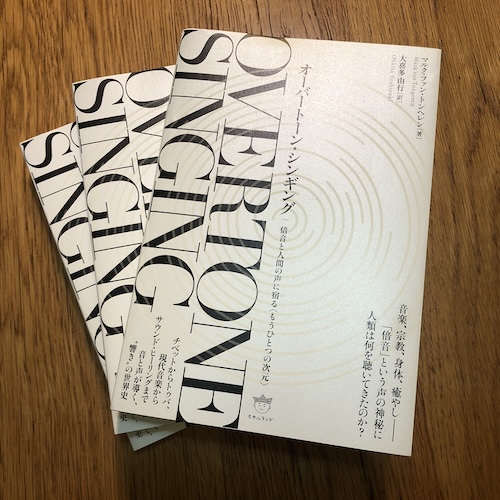
Out now: Japanese translation of my book Overtone Singing
発売中:私の著書『オーバートーン・シンギング』の日本語版
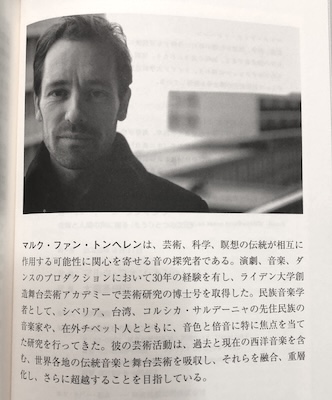
Recently I received my book Overtone Singing, translated into Japanese. What a nice surprise! I was not aware that my publisher was contacted by a Japanese agent shortly after the book came out in 2022. But recently it came to my attention, with no further details and no updates.
It is a neat, small-sized and quite thick book. Well-designed, beautiful typographic cover.
Including all the original illustrations, as far as I can see.
Translated by Ohkita Yoshiyuki and published by Hikaruland Publishing Co. Ltd.
A dream come true!
Link to Amazon Japan.
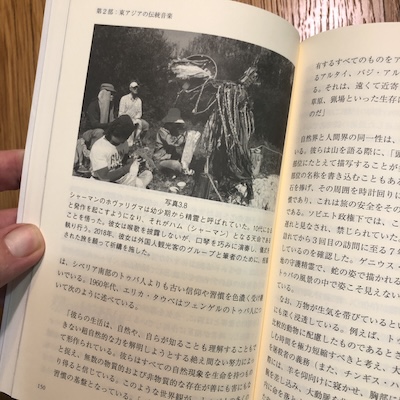
One of my first sources about Mongolian throat singing was a book and album devoted to a symposium held in Japan in the late 1970s. It contained articles and recordings, and the main source was the famous Sundui. Such a mystery still at that time! This was the very early 1990s. Then in 1993 I went to Tuva and met Japanese scholars and singers, and again in 1995. At that big symposium there were several important Japanese delegates: Makigami Koichi and Leo Tadagawa.

Makigami Koichi and Leo Tadagawa, 2nd and 3rd from left. International visitors at the Khöömei Festival, Kyzyl, Tuva, Russian Federation, 1995.
There is a strong connection with Central Asia, in particular Tuva and Mongolia, but also the Altay, Khakassiya. One of the very early movers in this area was Makigami Koichi, who set up a Tuva – Japan friendship association and kept on (and keeps on) coming back to Tuva and inviting musicians to Japan – also from Altay, like Bolot Bairyshev. Makigami and his company also organised tours and published albums of musicians from South Siberia, nearly always related to throat singing. I met Makigami-san again and again: first in Tuva, then in Germany where we performed with Alexander Lauterwasser’s device to transform sound into visuals (cymatics), later in New York City with Jong Zorn after we both performed there. Of course in the Netherlands, where he was a guest with our band Oorbeek at the International Jew’s Harp Festival in 2006 and in recent years several times in Taiwan.

When I was at another festival in Tuva in the year 2000, there were many young Japanese throat singers. They formed a group called Vions (which translates as ‘overtones’) and worked independently in different fields of art and performance. Another early adopter of many things Tuvan was Todoriki Masahiko: he spent lots of time travelling through Tuva to observe flora and fauna, collect pictures for his postcard editions, learn the language and collect songs and lyrics, and learn throat singing. He also came to Taipei to teach and perform.
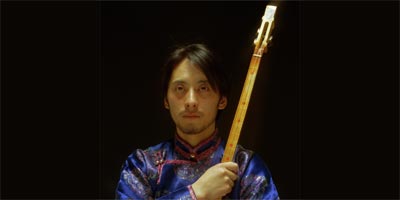
So far, most Japanese I met and heard were interested in, or based on, the traditional forms from Mongolia and Tuva. There have been several throat singing festivals in Japan, starting already in the early 2000s: a testament to their dedication to the original masters. Non-Japanese have often thought the Japanese have some kind of overtone singing of their own: indeed, the range of vocal styles and techniques is enormous. Among the very skilled voice types we find, for example, the (Buddhist) Shomyo chants of the Tendaï sect, which I always play for my R E S O N A N C E students. You can hear the overtones even when they do not make a conscious effort to sing them. (Michael Vetter confirmed this during his long-term stay in Japan from 1973-1983.)
Not many young people seemed to be interested in learning the non-guttural styles. But every once in a while I learnt about performers and composers who did extraordianry things with timbre, guttural sounds and/or overtones. Ken Ueno (not a Japanese citizen, I know) and Fuyuki Yamakawa belong in this category. I also consider the work Mandara Trilogy by Somei Satoh an exploration of vocal overtones, though it is not the main material.
In recent years, I started hearing a bit more from people interested in non-traditional overtone singing, but there must be much more than I know.
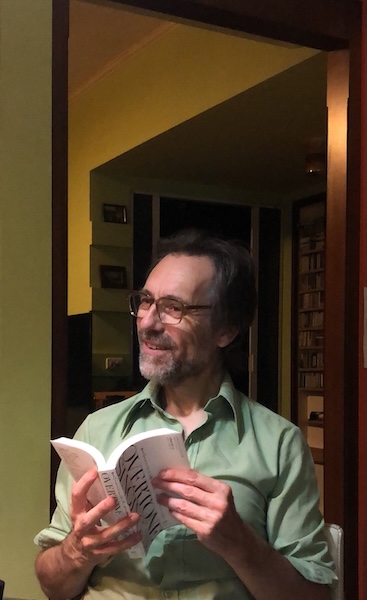
Link to Amazon Japan.