Walter Slosse

Töne im Sturm: Singing Parallel Overtones

About the unknown “parallel-third technique” of overtone singing

For decades I have known a technique of Western overtone singing that I heard perform only one time. Many singers use the technique on which it is based, which I call the L-technique, as their standard for singing overtones. But I suspect that this particular technique is unknown to most overtone singers. Since hearing the shimmering, glistening sound of this unique method, I practise it occasionally. Recently I notice it does not sound as clear as it used to, and so it is high time to share it with others, who then can also use it. I am now getting it back in shape again and will present this technique in a live performance as part of a longer piece, next month in my solo show In|nbalance in Potsdam. In this video I tell a bit more about it and show the technique.


I will give three workshops especially for Designing Voices in Potsdam about overtones and resonance stuffed with information and exercises about many overtone singing techniques, from various forms of Tibetan chant through Western techniques to Tuvan/Mongolian techniques.

So the technique has one clear characteristic that makes it stand out: it highlights two overtones while not sounding the overtone that is between them. This goes against the common wisdom of every practising overtone singer, which holds that you try to concentrate the sound energy in one clear, central overtone. With this little-known technique, it seems you sort of split this energy out again in two directions around one central overtone that you cannot hear. When normally you try to focus all energy on, say, overtone number 9, you now adjust your tongue so that the energy flows out to numbers 8 and 10, making both of them loud enough to be heard. A rather unusual procedure. Very characteristic is the combination of the seventh and the ninth overtones, leaving out number eight; and also nine combined with eleven (with number ten being inaudible). (For the microtonality / Just Intonation freaks and serious singers: more details about the overtone range at the bottom of this post)

For reasons I cannot fully fathom myself, I have never spoken to anybody about this technique: not with Michael Vetter, not with Borg Diem Groeneveld or with other overtone singers. Somehow it remained this special treasure all this time. It is possible others have heard it and know more: please drop me a line if you do. Since I do not know if Michael Vetter ever gave this technique a name, I need to come up with one. I usually think of it as the ‘parallel third technique’ but there can be a fourth in the low range and possibly seconds in the higher range. I find the parallel thirds the most striking element, however, so I prefer that name: the “parallel-third technique.”

Interesting detail: the storm created a special atmosphere in the church in Utrecht: this was also clearly palpable in the live broadcast itself. It was amplified by the storm we, listeners, heard at home, raging outside. This situation and the name Töne im Sturm is also very fitting for the theme of the In|nbalance program I am working on. Is it a coincidence that unusually strong winds are blowing around my place in Amsterdam for several days now, in September 2025, while I am working on this piece and this video? Every now and then the rain flies past my window almost horizontally. The wind produces ominous, low rumbles day and night; rustling sounds produced by thousands of leaves come and go in waves; and then there are the ‘ordinary’ sounds of wind, mid-range, between these high and low frequencies. Three stacked layers of sound. Just as in the parallel-third technique itself.

Michael Vetter with brezel (pretzel). Photo by Mark van Tongeren

The radio programme that featured Michael Vetter’s concert, baptised Töne im Sturm (‘Tones in the Storm’) by the singer, was De Wandelende Tak, which mostly featured traditional music from around the world, often original recordings by musicians, ethnomusicologists and other people with special knowledge of that tradition. I was a frequent guest myself in this program with recordings from Siberia, Mongolia, Kalmykia and other places. The overtone singing concert from Vetter was characteristic of the ambiguous status of overtone singing, because it is not traditional music, like the content of nearly all other episodes of De Wandelende Tak. The concert was organised by Diem Groeneveld, a long-time Dutch student of Michael Vetter and a fine overtone singer himself. Walter Slosse was the host who interviewed Groeneveld about Vetter before and after the concert, and it was broadcast by the VPRO.

This is my recording of the radio programme, made on a cassette and later transfered to the computer. There is a  silence towards the end for a short while, of which I am not sure at which stage it happened – probably during the A/D conversion.

After listening again, I conclude that Vetter’s technique was in an absolutely superb state at this point,

as can be heard  in all the ‘ordinary styles’of overtone singing. The parallel technique becomes clear particularly at around 12:45, and comes back several times later. 


Töne im Sturm.

Live radio broadcast for VPRO radio’s

De Wandelende Tak, mid-1990s.


Details about the range of overtones and their distances

For the overtone cogniscenti: the extremes on the recording of my own version are overtones ten and twelve, but I can go as high as twelve and fourteen, and as low as six and eight. Every time, the overtone in between them is not audible. Nearly all these combinations are variations of the interval of a third. The interesting thing is of course that every third is different, as the distance between the two tones grows smaller with every higher step on the harmonic scale. The H6 + H8 combination, my lowest combination, is a near-perfect fourth apart (497 cents, in case you were wondering), then next is the largest third H7 + H9 (a very large major third of 435 cents). The thirds progressively decrease their distance: the smallest and highest interval I could still sing clearly with this technique is a very small minor third of the overtones H12 + H14 (266 cents).

To hear this technique in its full splendour, come to Potsdam next month! And to learn more, I will give three workshops especially for Designing Voices in Potsdam about overtones and resonance stuffed with information and exercises about many overtone singing techniques, from various forms of Tibetan chant through Western techniques to Tuvan/Mongolian techniques. Check out all the details here.

For all workshop dates in Amsterdam/Potsdam/

Zürich/Vilnius/Ljubljana/Helsinki:

check my upcoming events page.


Ode aan Walter Slosse (1947-2016)

Een jaar geleden (op 1 augustus 2016) overleed VPRO programmamaker Walter Slosse, met wie ik vele programma’s maakte, vooral in de jaren negentig. Een week ervoor hadden we een bijeenkomst in Amsterdam gehad van Walter en enkele van zijn/onze oude vrienden en radiogasten. Daarin kreeg ik de kans een test te doen van een presentatie die ik kort erna voor TedX Taipei zou geven. Ik kreeg er vele waardevolle tips van de aanwezigen, die hun weerslag ook kregen in de uiteindelijke TedX talk.

Bovenal werd het een dag waarin allerlei prachtige reis-, muziek- en andere verhalen opgerakeld werden. Het was bijzonder omdat sommige gasten elkaar wel kenden van de radio maar elkaar nog nooit in levende lijve hadden ontmoet; en ook omdat het een soort reünie was rondom Walter’s legendarische programma De Wandelende Tak, dat in de 23 jaar dat het bestond (van 1984-2007) een grote schare trouwe luisteraars unieke verhalen muziek voorschotelde.

En toen kwam slechts enkele dagen later totaal onverwacht het bericht dat hij op reis in Lübeck overleden was. Ik was op weg naar Siberië en was alleen nog in staat op afstand een laatste groet te brengen aan Walter, middels de nu volgende herinneringen, die ook tijdens de begrafenis op 9 augustus voorgelezen werden.


…..paaaroooooleeee…… paaaroooooleeeee……

en dan die prachtige, welbespraakte, Vlaamse stem die op schaarse momenten vrijwel non-stop trancemuziek van over de hele wereld onderbrak. Het programma Senza Parole (‘zonder woorden’) bezorgde mij hallucinerende radio-uren, ook zonder de paddo’s. Ik raakte voorgoed verknocht aan Marokkaanse gnawa en Dr. John The Nighttripper; aan Griekse miroloi, Moondog en Sufi-gezangen, welke zó lang duurden dat ze wel nooit meer integraal op de Nederlandse radio te horen zullen zijn; en ik raakte ook voorgoed verknocht aan Walter zelf.
Ik ontdekte De Wandelende Tak, Walter’s wekelijkse prime-time radioprogramma gewijd aan musici en reizigers uit alle uithoeken van de aarde. Wonderlijke, dramatische en ontroerende verhalen over reizen ver weg en dichtbij, met vaak ongehoorde en onbekende muziek. En altijd weer die fascinerende, gloedvolle stem.

Mijn verzoek om meer informatie rond 1990 leidde tot een uitnodiging voor een bezoek aan de VPRO studio: de stem kreeg een gezicht, en er bleek een vrouw achter de schermen te zijn die evenzeer een drijvende kracht was achter de enorme productiviteit van De Wandelende Tak en andere programma’s. Walter Slosse en Magda van der Eecken leefden voor de radio, dat was duidelijk. Het waren gouden media-jaren (royale budgetten, en bijna alles mocht), en dankzij de tomeloze inzet en het alsmaar uitdijende netwerk van Walter en Magda stroomde er micro- en macrokredieten naar allerlei musici die anders nooit gehoord werden, tot ver buiten Nederland. Walter stak overal helpende handen toe en liep altijd over van nieuwe ideeën. Zo liet hij mij vorig jaar bij hem thuis een vernuftig zonnecellen-batterijpak zien dat hij in de jaren negentig regelde in Eindhoven, zodat Louis Sarno in het regenwoud maandenlang Pygmeeënliederen kon opnemen.

Een vroeg experimenteel model zonnepaneel dat Walter speciaal voor Louis Sarno bij Philips in Eindhoven regelde, zodat hij maandenlang het regenwoud in kon, onder andere om opnames van de Pygmeeën te maken.


Walter wist altijd een uitgebalanceerde koers te varen: hij gaf een stem aan onderdrukten, migranten en muzikale marginalen, maar dan zónder azijnsmaak, mét relativeringsvermogen en soms rake humor. Zijn dadendrang was gebaseerd op passie en overtuiging, en niet op één of ander post-koloniaal plichtsbesef. Hij bleef altijd op zoek naar de menselijke maat en had oog voor de breedst mogelijke context van muziek en cultuur.

Een sigaret losjes in de mond, nervositeit voor of tijdens de uitzending: het was ook duidelijk dat het wel degelijk een enorme inzet vergde om steeds weer met zoveel uiteenlopende programma’s, cd’s en concerten op de proppen te komen. Ik maakte me soms wel zorgen over de inspanningen die Walter leverde, maar het gesprek was eigenlijk nooit op hem zelf te brengen. Het ging over wat Walter om zich heen zag en hoorde, en wat hij vond dat er moest gebeuren.

Het afgelopen jaar viel mij aan niets te merken dat er iets mankeerde aan Walter: na een weerzien bij hem en zijn partner Eline thuis (zijn vrouw Magda van der Eecken overleed in februari 2012), hadden we regelmatig contact via Skype, blikten we terug en passeerden allerlei plannen de revue. Het leidde tot een door Walter en Heiko Jessayan georganiseerde bijeenkomst, nu slechts twee weken geleden: een geweldig weerzien van oude bekenden. Nog eenmaal kregen we de kans om deelgenoot te zijn van Walter’s aanstekelijke enthousiasme voor ongewone geluiden.

In maart van dit jaar publiceerde Walter een bericht over prachtige liederen uit de Catalaanse Llibre Vermell, uitgevoerd door Hesperion XX (‘Hesperion twintig’). Hij noemde het bericht Ad Mortem en haalt onder andere de volgende tekst aan:

 
Vita brevis breviter, in brevi finietur,


mors venit velociter quae neminem veretur.


Life is short, and shortly it will end;


death arrives faster than anyone fears.


Dat te lezen is één ding. Dat te voelen is iets heel anders.

De pijnlijke boodschap van die tekst drong vorige week pas echt tot me door, terwijl ik de hele dag naar de uitvoeringen op jouw blog luisterde.


Senza parole, zonder jouw stem en persoon moeten we verder, maar je stem zal nog lang nagalmen in de digitale ether. In Siberië, waar ik dit schrijf, zal er vandaag ten afscheid een keelgezang rondgalmen door de taiga, langs de oevers van de Jenisei.


En hier is die ode aan Walter die ik vorig jaar zong in Erzhei, Toeva, tijdens de keelzangreis die ik maakte met Taiwanese studenten.


Uiteraard zijn er sinds zijn overlijden meerdere getuigenissen van Walter’s bijzondere journalistieke carrière verschenen. Enkele oude bekenden uit de ‘wereldmuziek’ haalden herinneringen op in een speciale uitzending van Fred Gales’ De Klankbron, tezamen met muziekfragmenten die ooit te horen waren in Walter’s De Wandelende Tak.
 

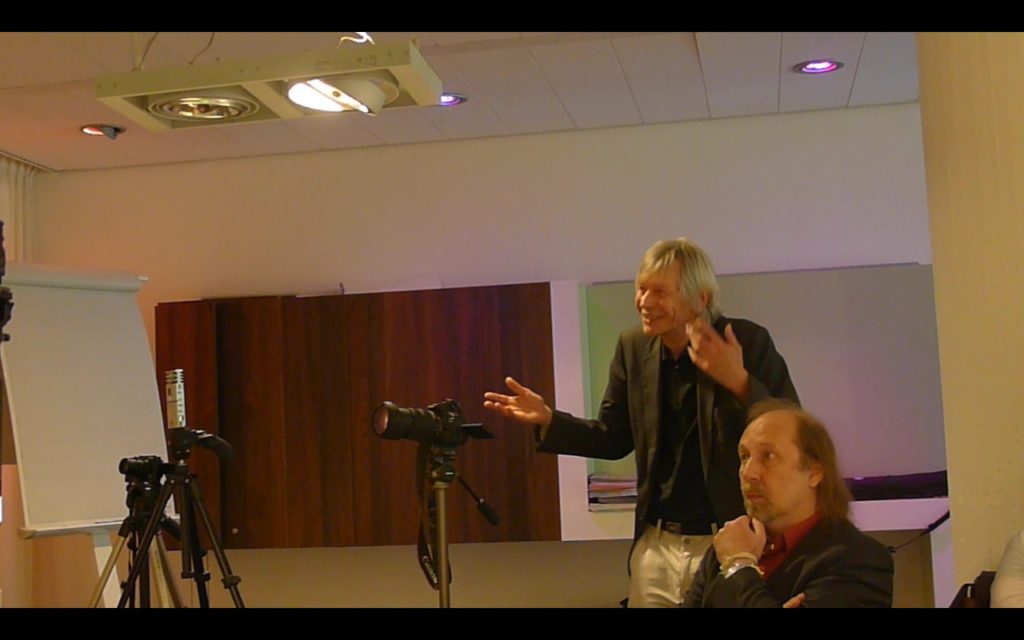
Walter Slosse (l) en Fred Gales tijdens de bijeenkomst, een week voor Walter’s dood.


Een andere oudgediende van de VPRO, Peter Flik, herinnerde zich een amusant voorval toen hij met Walter door een van muziek verlaten Leipzig reisde. Er dook ook een filmpje op, gemaakt door een voormalig student van een sociale academie, die Walter in 1978 in zijn bezemkast filmde, waar hij een complete radiostudio had geïnstalleerd. Hoe dat ging staat in een blogpost van Ronald van den Boogaard.


Nog altijd te lezen zijn het blog Websporen, met dichter Rob Van de Zande, het blog Reizen met Charly dat Walter samen met zijn partner Eline Robin maakte, en het blog Charley’s Blik, dat Eline nog regelmatig aanvult, en waarmee de geest van Walter levend blijft. Walter’s boeiende biografie is na te lezen op Walter Slosse’s Alfabet. Op dat blog zijn ook talloze uitzendingen terug te luisteren, verwerkt in journalistieke bijdragen die tientallen jaren van Walter’s radiocarrière bestrijken. Daaronder is een uitzending die ik voor Walter maakte in april 1996. Te zijner tijd zal ik hier nog wat andere uitzendingen die ik met Walter maakte aan toevoegen.