Designing Voices

Töne im Sturm: Singing Parallel Overtones

About the unknown “parallel-third technique” of overtone singing

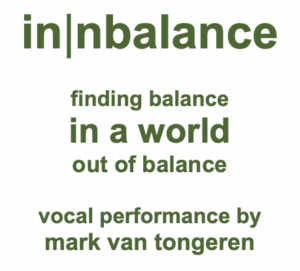
For decades I have known a technique of Western overtone singing that I heard perform only one time. Many singers use the technique on which it is based, which I call the L-technique, as their standard for singing overtones. But I suspect that this particular technique is unknown to most overtone singers. Since hearing the shimmering, glistening sound of this unique method, I practise it occasionally. Recently I notice it does not sound as clear as it used to, and so it is high time to share it with others, who then can also use it. I am now getting it back in shape again and will present this technique in a live performance as part of a longer piece, next month in my solo show In|nbalance in Potsdam. In this video I tell a bit more about it and show the technique.


I will give three workshops especially for Designing Voices in Potsdam about overtones and resonance stuffed with information and exercises about many overtone singing techniques, from various forms of Tibetan chant through Western techniques to Tuvan/Mongolian techniques.

So the technique has one clear characteristic that makes it stand out: it highlights two overtones while not sounding the overtone that is between them. This goes against the common wisdom of every practising overtone singer, which holds that you try to concentrate the sound energy in one clear, central overtone. With this little-known technique, it seems you sort of split this energy out again in two directions around one central overtone that you cannot hear. When normally you try to focus all energy on, say, overtone number 9, you now adjust your tongue so that the energy flows out to numbers 8 and 10, making both of them loud enough to be heard. A rather unusual procedure. Very characteristic is the combination of the seventh and the ninth overtones, leaving out number eight; and also nine combined with eleven (with number ten being inaudible). (For the microtonality / Just Intonation freaks and serious singers: more details about the overtone range at the bottom of this post)

For reasons I cannot fully fathom myself, I have never spoken to anybody about this technique: not with Michael Vetter, not with Borg Diem Groeneveld or with other overtone singers. Somehow it remained this special treasure all this time. It is possible others have heard it and know more: please drop me a line if you do. Since I do not know if Michael Vetter ever gave this technique a name, I need to come up with one. I usually think of it as the ‘parallel third technique’ but there can be a fourth in the low range and possibly seconds in the higher range. I find the parallel thirds the most striking element, however, so I prefer that name: the “parallel-third technique.”

Interesting detail: the storm created a special atmosphere in the church in Utrecht: this was also clearly palpable in the live broadcast itself. It was amplified by the storm we, listeners, heard at home, raging outside. This situation and the name Töne im Sturm is also very fitting for the theme of the In|nbalance program I am working on. Is it a coincidence that unusually strong winds are blowing around my place in Amsterdam for several days now, in September 2025, while I am working on this piece and this video? Every now and then the rain flies past my window almost horizontally. The wind produces ominous, low rumbles day and night; rustling sounds produced by thousands of leaves come and go in waves; and then there are the ‘ordinary’ sounds of wind, mid-range, between these high and low frequencies. Three stacked layers of sound. Just as in the parallel-third technique itself.

Michael Vetter with brezel (pretzel). Photo by Mark van Tongeren

The radio programme that featured Michael Vetter’s concert, baptised Töne im Sturm (‘Tones in the Storm’) by the singer, was De Wandelende Tak, which mostly featured traditional music from around the world, often original recordings by musicians, ethnomusicologists and other people with special knowledge of that tradition. I was a frequent guest myself in this program with recordings from Siberia, Mongolia, Kalmykia and other places. The overtone singing concert from Vetter was characteristic of the ambiguous status of overtone singing, because it is not traditional music, like the content of nearly all other episodes of De Wandelende Tak. The concert was organised by Diem Groeneveld, a long-time Dutch student of Michael Vetter and a fine overtone singer himself. Walter Slosse was the host who interviewed Groeneveld about Vetter before and after the concert, and it was broadcast by the VPRO.

This is my recording of the radio programme, made on a cassette and later transfered to the computer. There is a  silence towards the end for a short while, of which I am not sure at which stage it happened – probably during the A/D conversion.

After listening again, I conclude that Vetter’s technique was in an absolutely superb state at this point,

as can be heard  in all the ‘ordinary styles’of overtone singing. The parallel technique becomes clear particularly at around 12:45, and comes back several times later. 


Töne im Sturm.

Live radio broadcast for VPRO radio’s

De Wandelende Tak, mid-1990s.


Details about the range of overtones and their distances

For the overtone cogniscenti: the extremes on the recording of my own version are overtones ten and twelve, but I can go as high as twelve and fourteen, and as low as six and eight. Every time, the overtone in between them is not audible. Nearly all these combinations are variations of the interval of a third. The interesting thing is of course that every third is different, as the distance between the two tones grows smaller with every higher step on the harmonic scale. The H6 + H8 combination, my lowest combination, is a near-perfect fourth apart (497 cents, in case you were wondering), then next is the largest third H7 + H9 (a very large major third of 435 cents). The thirds progressively decrease their distance: the smallest and highest interval I could still sing clearly with this technique is a very small minor third of the overtones H12 + H14 (266 cents).

To hear this technique in its full splendour, come to Potsdam next month! And to learn more, I will give three workshops especially for Designing Voices in Potsdam about overtones and resonance stuffed with information and exercises about many overtone singing techniques, from various forms of Tibetan chant through Western techniques to Tuvan/Mongolian techniques. Check out all the details here.

For all workshop dates in Amsterdam/Potsdam/

Zürich/Vilnius/Ljubljana/Helsinki:

check my upcoming events page.


World première In|nbalance at Designing Voices

Since the beginning of this year I am preparing a new solo performance. I haven’t conceived of a big solo work for many years; most of my work in the last two decades was about collaborations. I am delighted to announce that I was invited by Alex Nowitz: friend, composer, performer and mastermind behind the Designing Voices Festival, to present my new work there. I was already planning a longer stay in Europe, from early September to early December, so this festival, running from 9 to 12 October 2025, was a perfect match. In the first half of 2025 I have been making design sketches, collecting all kinds of notes, and created several new pieces for the larger work.
But more about that solo piece later. First, I will give an exciting 3-day workshop Overtone Singing and Resonance at Designing Voices, which can better be booked early. So here is the info, in English and German – we will see which language we will use, both can do. The English pdf is here, and then I let Alex introduce my workshop in German.


(Start of) workshop announcement in German

Im Rahmen dessen findet ein dreitägiger Workshop von Mark van Tongeren statt:
OBERTONGESANG UND RESONANZ.
Alle weiterführenden Informationen siehe PDF im Anhang!
Mark van Tongeren kenne ich seit Ende der 1990er Jahre. Er lebt derzeit mit seiner Familie in Taipeh und reist wegen der DESIGNING VOICES 2025 nach Potsdam an! Mark ist ein Spezialist auf dem Gebiet des Obertongesangs. Ich kenne niemanden, der die unterschiedlichen Ansätze beim Obertonsingen so exzellent beherrscht wie er und sie darüber hinaus auch vermitteln kann! Mark hat alle fernasiatischen Kulturkreise besucht und die jeweiligen Gesangarten in Tuva, Tibet, Mongolei, Kasachstan, usw. studiert. Er berherrscht die meiste Kehlsangtechniken aus dem turko-mongolischen Kulturkreis: Sygyt, Kagyraa, Khöömei, usw. Aber auch, was europäische Traditionen des Obertongesangs angeht, kann er getrost als Experte bezeichnet werden. Er weiss, die Unterschiede zwischen diesen und fernasiatischen Ansätzen hör- und erfahrbar zu machen.
Mark hat einen PhD an der Uni Leiden erworben und ein Buch zum Thema veröffentlicht: “Overtone Singing – Harmonic Dimensions of the Human Voice“ (hrg. Terra Nova ). Zudem ist Mark ein wunderbarer Pädagoge und äusserst liebenswerter Mensch.
Der dreitägige Workshop gelangt zusätzlich zu einer Aschlußpräsentation in der Französischen Kirche Potsdam am 12. Okt. Dies findet ab einer Teilnehmeranzahl von mind. 5 Personen statt.
Natürlich würde es mich sehr freuen, wenn sich viele Begeisterte für den Workshop finden. Ich kann das nur jedem/er empfehlen, der/die Interesse an der Erweiterung der eigenen Stimmmöglichkeiten sowohl alleine als auch im Verbund des chorischen Klangerlebinsses hat. Spread the word!

(End of workshop announcement in German)


About my new work In|nbalance

The title of my new work is In|nbalance. It aims to bring together a wide range of vocal and instrumental techniques with questions such as: what can my voice still express when the world seems to be seriously out of balance (hence ‘imbalance‘)? What, if any, are the sounds I can make with my voice and its extensions (instrumental and electronic) that bring balance (hence ‘in balance‘)? How to find my own ‘balance’ as a performer? What new or old sounds do I want to use? And what are their effects, in a time when listening to one another in the world at large reaches a lowpoint I never experienced in my lifetime? How do I give a voice to the news about wars, climate change and other disruptions that we hear about every day? Should I – who never was good at using words in my musical language anyway – look for words to express this struggle, or keep on avoiding verbal, discursive messages altogether?
So far, many tests have been done and they go in either direction: no text <<>> lots of text. It is a new process for me because I never (except a few times, like that TED-x talk) felt an urge to ‘speak’ or to ‘sing about’ something. Now I can no longer pretend I have nothing on my mind or nothing to say: I do. I am experimenting with various methods to incorporate words and meaning – this is my biggest challenge, really. There is also plenty of new-sound-making going on: I look for ways to consolidate overtone singing skills and ideas into more rigorous pieces. Also something I have never really paid enough attention to. So even though I build on skills I posses since a long time, I am pushing myself into new directions.
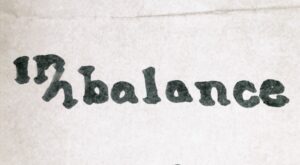
As for the title itself: it must be handwritten to express the ambiguity in/im balance. I made some sketches only, and I am still searching for other ways. I am also not sure yet whether I want to go for an extreme colour scheme
or keep it more subdued.
The Festival Designing Voices
Alex Nowitz’s Designing Voices Festival is running for the fourth time now. It is a unique festival in that it puts the voice centre stage, in confrontation/extension/collaboration with old and new electronic and digital tools and instruments. A fantastic recurring tool is Alex’s Strophonion, which he developed over many years. I remember him spending weeks at the famous Amsterdam institute STEIM, at a time when its downfall began. Just in time to connect with one of the places that has been instrumental in developing and promoting musical sound generated by hand/arm gestures, since the 1970s. There is the first time I heard Alex’ perform with an earlier prototype of the Strophonion.
Designing Voices does what it says: it pushes for the voice to stretch into new directions, and it does so in a wonderful context of instrumental and electronic support, often including video works. I really can’t emphasise how happy I am with Alex’ invitation, just at a point where I had decided to come up with a full, through-developed work. Designing Voices is a fantastic platform with top performers and a critical audience. Watch this trailer of Designing Voices 2021 to see how wide the scope is (and to see the Church where I will also present my piece):


Klangsinn is the theme of this year. There are 6 concerts and 8 performances taking place. This is the full program for this year (2025) with 20 artists from around the world. Or check the link.
DESIGNING VOICES: Klangsinne
Potsdam, 09.-12. Okt. 2025
Die menschliche Stimme als Kunstobjekt, in all ihrer Breite und Vielfältigkeit live dargeboten, steht im Zentrum des Internationalen Festivals für vokale Performancekunst, Klang & Musik DESIGNING VOICES. Die Kunststimmen erweitern sich durch den Einsatz von Live-Elektronik oder sie treten in Dialog mit akustischen und elektronischen Instrumenten sowie mit Objekten. Das Festival findet als Biennale zum dritten Mal in Potsdam statt. Unter dem diesjährigen Motto „Klangsinne“ beleuchtet das Festival die sinnlichen Aspekte von Stimmklängen und erkundet gleichzeitig den Sinn von Klang im Spiel mit und ohne Sprache.
Es stellen sich 20 Performer:innen in 8 Performances (6 Konzerte) aus dem In- und Ausland vor.
==========
W O R K S H O P — INFOS + ANMELDUNG
==========
Das gesamte Festival DESIGNING VOICES: „Klangsinne“ (Potsdam 09.–12. Okt.)
Eröffnung (Tag 1)
Vom Sinn zum Klang (Tag 2)
Die lange Nacht der kuriosen Stimmen (Tag 3)
Vom Klang zum Sinn (Tag 4)
WORKSHOP Obertongesang (3 Tage)
==========
P R O G R A M M
_____
ERÖFFNUNG
museum FLUXUS+ | 09. Okt. (19:00)
=> Infoveranstaltung mit Gesprächen und Videos
(freier Eintritt!)
• Casey Moir (AU/SE)
• Meinrad Kneer (DE)
• Natalia Pschenitschnikova (RU/DE)
• Mark van Tongeren (NL/TW)
• Alex Nowitz (DE)
_____
VOM SINN ZUM KLANG
fabrik Potsdam | 10. Okt.
=> Konzert 1 (19:00)
Ensemble KLANGPAKT (DE/FR)
• Matthias Badczong (DE, Klarinetten)
• Christine Paté (FR/DE, Vierteltonakkordeon)
• Matthias Bauer (DE, Kontrabass, Komposition)
• Alex Nowitz (DE, Stimme, Strophonion, Komposition)
=> Konzert 2 (21:00)
Meinrad Kneers PHOSPHOROS Ensemble (DE)
• Angela Postweiler (DE, Sopran)
• Uli Pleßmann (DE, Sprecher)
• Frank Gratkowski (DE, Holzblasinstrumente)
• Ulrike Brand (DE, Violoncello)
• Meinrad Kneer (DE, Kontrabass, Leitung, Komposition)
_____
DIE LANGE NACHT DER KURIOSEN STIMMEN
fabrik Potsdam | 11. Okt.
=> Konzert 3 (19:00)
VIVA VOCAL Ensemble (SE/AU)
• Klara Ahlersten (SE, Stimme und Objekte)
• Maria Palmqvist (SE, Stimme und Objekte)
• Amanda Törngren (SE, Stimme und Objekte)
• Hannah Tolf (SE, Stimme und Objekte)
• Casey Moir (AU/SE, Stimme und Objekte, Leitung, Komposition)
=> Konzert 4, Teil 1 (20:30)
• Natalia Pschenitschnikova (RU/DE, Stimme, Elektronik, Objekte)
=> Konzert 4, Teil 2 (21:15)
IN MY WATER (FR/DE)
• Guylaine Cosseron (FR, Stimme)
• Diemo Schwarz (DE/FR, Computer, Live-Elektronik)
=> Konzert 5 (22:30)
SONIC ALCHEMY meets Alex Nowitz (PT, IT, DE)
• Sofia Borges (PT, Perkussion, Elektronik)
• Klaus Janek (IT, Kontrabass, Elektronik)
• Alex Nowitz (DE, Stimme, Live-Elektronik [Strophonion])
_____
VOM KLANG ZUM SINN
Französische Kirche Potsdam | 12. Okt.
=> Konzert 6, Teil 1 (19:00)
Mark van Tongeren (NL/TW, Stimme, Effektpedal, Kaosspad, Maultrommel, Objekte)
=> Konzert 6, Teil 2 (20:00)
Casey Moir (AU/SE, Stimme, Effektpedal)
==========
Alle Konstellationen von Solo, Duo, Trio, Quartett bis hin zum Quintett werden in 6 Konzerten mit insgesamt 8 Performances präsentiert. Das Festival vergibt zwei Kompositionsaufträge, die mit Meinrad Kneer’s PHOSPHOROS Ensemble (DE) und Casey Moir’s VIVA VOCAL Ensemble (SE) zur Uraufführung gelangen.
An zwei Tagen ist DESIGNING VOICES Gast in der fabrik Potsdam. Die Themen lauten:
• Vom Sinn zum Klang (Fr., 10. Okt., 19:00)
• Die lange Nacht der kuriosen Stimmen (Sa., 11. Okt., 19:00)
Zwei Soloperformances beschließen das Festival in der Französischen Kirche Potsdam und sehen sich folgender Thematik verpflichtet:
• Vom Klang zum Sinn (So., 12. Okt., 19:00)
Die Eröffnungsveranstaltung mit einer Auswahl der am Festival beteiligten Künstler:innen findet im Potsdamer museum FLUXUS+ statt:
• Eröffnung– Infoveranstaltung mit Gesprächen und Videos (Do., 9.Okt., 19:00)
Der Eintritt hierfür ist frei.
Gefördert vom Musikfonds e.V. und Ministerium für Wissenschaft, Forschung und Kultur des Landes Brandenburg
==========
TICKETS (Abendkasse)
1 Einzelkonzert
15.- € (regulär) / 10.- € (ermäßigt)
Tagespass (alle Konzerte pro Tag)
25.- € / 15.- €
Festivalpass (alle Konzerte an den drei Tagen)
60.- € / 40.- €
Freier Eintritt zur Eröffnung (Infoveranstaltung) am 9. Okt. im museum FLUXUS+.
_____
Workshop
60.- € / 40.- €
ANMELDUNG ZUM WORKSHOP
designing-voices@nowitz.de
• Workshopteilnehmende erhalten vergünstigten Zugang zu den Performances für 5.- € pro Konzert.
==========
TEAM
• Künstlerische Leitung: Alex Nowitz
• Produktionsleitung: Frauke Niemann
• Technische Leitung: Tamás Blénessy (museum FLUSXUS+), Ralf Grüneberg (fabrik Potsdam) & Michael Zillmann (Französische Kirche Potsdam)
• Mitarbeit: Brenda Alamilla (Grafik)
• Dokumentation: Sirko Knüpfer (Video), Leon Fiedler (Audio) & Sebastian Rausch (Foto)
==========
[ENGLISH]
The festival DESIGNING VOICES 2025 features 6 concerts and a workshop by Mark Van Tongeren on Overtone Singing and Resonance!
The third edition of the international festival for vocal performance art, sound & music explores the theme of “Klangsinne” [Senses for Sound].
20 artists perform in 6 concerts with 8 performance acts over 4 days, with two newly commissioned works.
09 Oct · Opening/info event @ museum FLUXUS+
10 Oct · 2 concerts @ fabrik Potsdam
11 Oct · 3 concerts @ fabrik Potsdam
12 Oct · 1 concert @ Französische Kirche
All involved artists
(in alphabetical order)
• Sara Abazari (IR, composition)
• Klara Ahlersten (SE, voice and objects)
• Matthias Badczong (DE, clarinets)
• Matthias Bauer (DE, double bass, voice composition)
• Sofia Borges (PT, percussion, electronics)
• Ulrike Brand (DE, violoncello)
• Guylaine Cosseron (FR, voice)
• Frank Gratkowski (DE, reeds)
• Klaus Janek (IT, double bass, electronics)
• Meinrad Kneer (DE, double bass, direction, composition)
• Casey Moir (AU/SE, voice and objects, direction, composition),
• Alex Nowitz (DE, voice, strophonion, composition)
• Maria Palmqvist (SE, voice and objects)
• Christine Paté (FR/DE, quarter tone accordion)
• Uli Pleßmann (DE, speaker)
• Angela Postweiler (DE, soprano)
• Natalia Pschenitschnikova (RU/DE, voice, electronics, objects)
• Diemo Schwarz (DE/FR, computer, live-electronics)
• Amanda Törngren (SE, voice and objects)
• Hannah Tolf (SE, voice and objects)
• Mark van Tongeren (NL/TW, voice, kaosspad, objects)
==========
Overtone singer and ethnomusicologist Mark Van Tongeren gives a three-day workshop on Overtone Singing and Resonance.
09–11 Oct · Workshop (opt. performance on 12 Oct)
Potsdam (DE), 9–12 Oct. 2025.
Venues: fabrik Potsdam, Französische Kirche Potsdam, museum FLUXUS+ & Treffpunkt Freizeit – Familienzentrum und Mehrgenerationenhaus
Supported by the Musikfonds e.V. funded by the Federal Government Commissioner for Culture and Media and by the Ministry for Science, Research and Culture of the Land Brandenburg [Ministerium für Wissenschaft, Forschung und Kultur].
==========
PHOTO CREDITS
Casey Moir • PHOTO Dawid Laskowski
Mark van Tongeren • PHOTO Yi-Jin Xie
Ensemble KLANGPAKT • PHOTO_COLLAGE
• Matthias Bauer • PHOTO Peter Gannushkin
• Matthias Badczong & Christine Paté • PHOTO T. Tarczynski
• Alex Nowitz • PHOTO Oscar Loeser
Meinrad Kneers PHOSPHOROS Ensemble • PHOTO Tito Knapp
VIVA VOCAL Ensemble • PHOTO Ingeborg Zachariassen
Natalia Pschenitschnikova • Foto German Vinogradov
IN THE WATER (Guylaine Cosseron. Diemo Schwarz) • PHOTO Ivan Mrsic
SONIC ALCHEMY meets Alex Nowitz • PHOTO Denise Ripplefinger
#klaraahlersten (SE, Stimme und Objekte)
#matthiasbadczong (DE, Klarinetten)
#MatthiasBauer (DE, Kontrabass, Stimme, Komposition)
#sofiaborges (PT, Perkussion, Elektronik)
#ulrikebrand (DE, Violoncello)
#guylainecosseron (FR, Stimme)
#frankgratkowski (DE, Holzblasinstrumente)
#klausjanek (IT, Kontrabass, Elektronik)
#meinradkneer (DE, Kontrabass, Leitung, Komposition)
#caseymoir (AU/SE, Stimme und Objekte, Leitung, Komposition),
#alexnowitz (DE, Stimme, Strophonion, Komposition)
#mariapalmqvist (SE, Stimme und Objekte)
#ChristinePaté (FR/DE, Vierteltonakkordeon)
#ulipleßmann (DE, Sprecher)
#angelapostweiler (DE, Sopran)
#nataliapschenitschnikova (RU/DE, Stimme, Elektronik, Objekte)
#diemoschwarz (DE/FR, Computer, Live-Elektronik)
#AmandaTörngren (SE, Stimme und Objekte)
#hannahtolf (SE, Stimme und Objekte)
#markvantongeren (NL/TW, Stimme, Effektpedal, Objekte)
Afterthought: this is the third time in a few years that I present new work in Germany: 2 years ago I performed at the Ancient Trance festival in Leipzig, also in a church, and before that the German-Chinese-Mongolian composer Yang Song invited me to contribute pre-recorded throat singing and other Mongolian-related vocal styles for her new multichannel electro-acoustic work In Einem Moment, broadcast live on German radio.

Winter – Spring 2026 Program


Concerts, workshops and other upcoming events.

Details below

近期音樂會、工作坊與活動


聲音的共鳴 年度團體 R E S O N A N C E   YEARGROUP 2026

The finest and most complete in-person introduction to overtone singing and

overall resonance of voice, mind and body, running for over ten years.

R E S O N A N C E  2026: February – May 2026

– 4 weeks online

– 2 x 4 days group practise in Hualien

Go to the event page:

R E S O N A N C E   X (10) – 2026

Early Bird Registration started!

Bilingual course (English/ Mandarin)


2026226日到32日 /26 February – 2 March, 2026

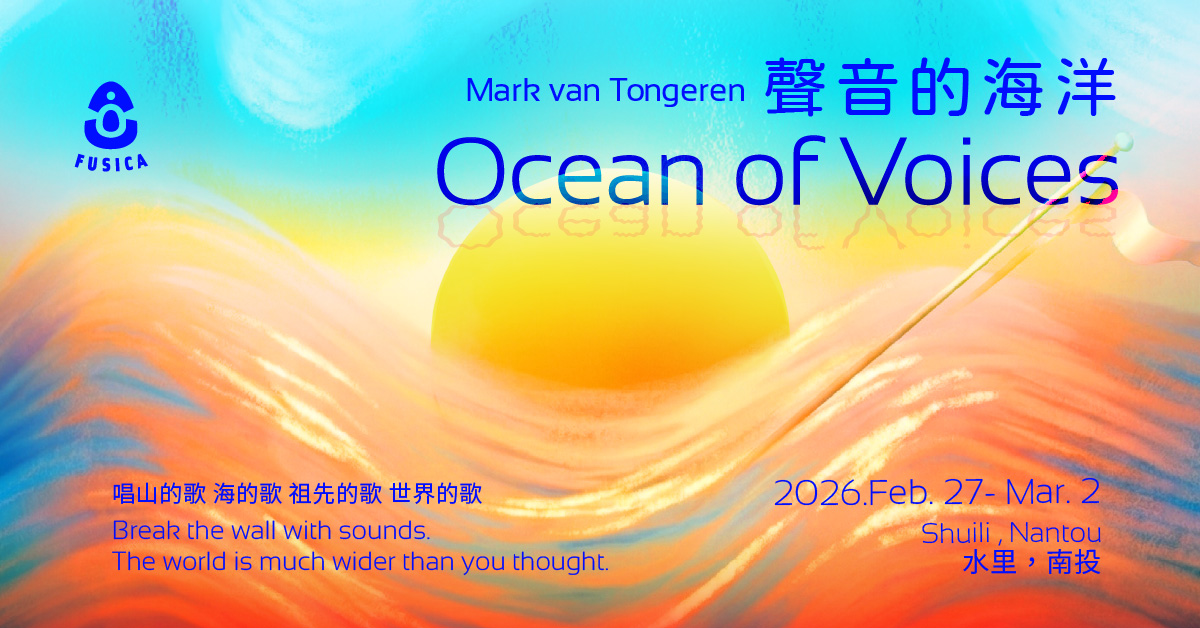
2026 Ocean of Voices with the Bunun / 2026 和布農族一起歌唱 聲音的海洋工作坊(額滿)

南投水里 老五民宿

Shuili, Nantou, Taiwan

Go to the event page:


Weekly Voice Yoga classes in Taipei.


Not found what you are looking for?

Tell us so we can help you.