About the unknown “parallel-third technique” of overtone singing
For decades I have known a technique of Western overtone singing that I heard perform only one time. Many singers use the technique on which it is based, which I call the L-technique, as their standard for singing overtones. But I suspect that this particular technique is unknown to most overtone singers. Since hearing the shimmering, glistening sound of this unique method, I practise it occasionally. Recently I notice it does not sound as clear as it used to, and so it is high time to share it with others, who then can also use it. I am now getting it back in shape again and will present this technique in a live performance as part of a longer piece, next month in my solo show In|nbalance in Potsdam. In this video I tell a bit more about it and show the technique.
I will give three workshops especially for Designing Voices in Potsdam about overtones and resonance stuffed with information and exercises about many overtone singing techniques, from various forms of Tibetan chant through Western techniques to Tuvan/Mongolian techniques.
So the technique has one clear characteristic that makes it stand out: it highlights two overtones while not sounding the overtone that is between them. This goes against the common wisdom of every practising overtone singer, which holds that you try to concentrate the sound energy in one clear, central overtone. With this little-known technique, it seems you sort of split this energy out again in two directions around one central overtone that you cannot hear. When normally you try to focus all energy on, say, overtone number 9, you now adjust your tongue so that the energy flows out to numbers 8 and 10, making both of them loud enough to be heard. A rather unusual procedure. Very characteristic is the combination of the seventh and the ninth overtones, leaving out number eight; and also nine combined with eleven (with number ten being inaudible). (For the microtonality / Just Intonation freaks and serious singers: more details about the overtone range at the bottom of this post)
For reasons I cannot fully fathom myself, I have never spoken to anybody about this technique: not with Michael Vetter, not with Borg Diem Groeneveld or with other overtone singers. Somehow it remained this special treasure all this time. It is possible others have heard it and know more: please drop me a line if you do. Since I do not know if Michael Vetter ever gave this technique a name, I need to come up with one. I usually think of it as the ‘parallel third technique’ but there can be a fourth in the low range and possibly seconds in the higher range. I find the parallel thirds the most striking element, however, so I prefer that name: the “parallel-third technique.”
Interesting detail: the storm created a special atmosphere in the church in Utrecht: this was also clearly palpable in the live broadcast itself. It was amplified by the storm we, listeners, heard at home, raging outside. This situation and the name Töne im Sturm is also very fitting for the theme of the In|nbalance program I am working on. Is it a coincidence that unusually strong winds are blowing around my place in Amsterdam for several days now, in September 2025, while I am working on this piece and this video? Every now and then the rain flies past my window almost horizontally. The wind produces ominous, low rumbles day and night; rustling sounds produced by thousands of leaves come and go in waves; and then there are the ‘ordinary’ sounds of wind, mid-range, between these high and low frequencies. Three stacked layers of sound. Just as in the parallel-third technique itself.

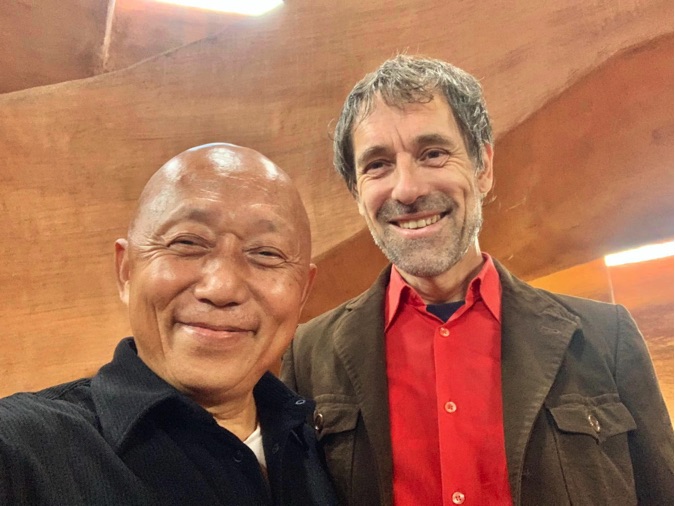
Michael Vetter with brezel (pretzel). Photo by Mark van Tongeren
The radio programme that featured Michael Vetter’s concert, baptised Töne im Sturm (‘Tones in the Storm’) by the singer, was De Wandelende Tak, which mostly featured traditional music from around the world, often original recordings by musicians, ethnomusicologists and other people with special knowledge of that tradition. I was a frequent guest myself in this program with recordings from Siberia, Mongolia, Kalmykia and other places. The overtone singing concert from Vetter was characteristic of the ambiguous status of overtone singing, because it is not traditional music, like the content of nearly all other episodes of De Wandelende Tak. The concert was organised by Diem Groeneveld, a long-time Dutch student of Michael Vetter and a fine overtone singer himself. Walter Slosse was the host who interviewed Groeneveld about Vetter before and after the concert, and it was broadcast by the VPRO.
This is my recording of the radio programme, made on a cassette and later transfered to the computer. There is a silence towards the end for a short while, of which I am not sure at which stage it happened – probably during the A/D conversion.
After listening again, I conclude that Vetter’s technique was in an absolutely superb state at this point,
as can be heard in all the ‘ordinary styles’of overtone singing. The parallel technique becomes clear particularly at around 12:45, and comes back several times later.
Töne im Sturm.
Live radio broadcast for VPRO radio’s
De Wandelende Tak, mid-1990s.
Details about the range of overtones and their distances
For the overtone cogniscenti: the extremes on the recording of my own version are overtones ten and twelve, but I can go as high as twelve and fourteen, and as low as six and eight. Every time, the overtone in between them is not audible. Nearly all these combinations are variations of the interval of a third. The interesting thing is of course that every third is different, as the distance between the two tones grows smaller with every higher step on the harmonic scale. The H6 + H8 combination, my lowest combination, is a near-perfect fourth apart (497 cents, in case you were wondering), then next is the largest third H7 + H9 (a very large major third of 435 cents). The thirds progressively decrease their distance: the smallest and highest interval I could still sing clearly with this technique is a very small minor third of the overtones H12 + H14 (266 cents).
To hear this technique in its full splendour, come to Potsdam next month! And to learn more, I will give three workshops especially for Designing Voices in Potsdam about overtones and resonance stuffed with information and exercises about many overtone singing techniques, from various forms of Tibetan chant through Western techniques to Tuvan/Mongolian techniques. Check out all the details here.
For all workshop dates in Amsterdam/Potsdam/
Zürich/Vilnius/Ljubljana/Helsinki:
check my upcoming events page.